

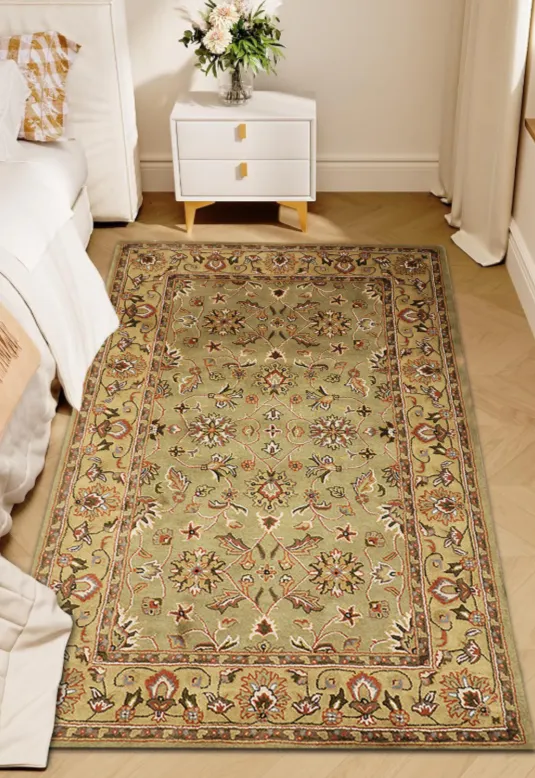
A lobby has about ten seconds to make an impression. A boardroom needs to feel considered without distracting from the actual discussion. A boutique hotel room has to feel personal at a scale that’s anything but. Hand-tufted carpets have quietly become the default across these settings, and not just because of price; though price is certainly part of it. Here’s what’s actually driving that.
1. Timelines That Match How Commercial Projects Actually Run
Fit-outs don’t bend for craftsmanship the way a private home renovation might. There’s an opening date, a client walkthrough, a launch. A hand-tufted carpet can go from design to delivery in a fraction of the time a fully hand-knotted piece needs, and for a designer working against a fixed deadline, that gap often settles the conversation before anything else gets discussed.
2. Sizing Built Around The Room, Not The Loom
Reception desks. Irregular lobby footprints. A boardroom table that’s twelve feet of solid walnut and needs a rug to match exactly. Standard residential dimensions rarely apply in commercial interiors. Because a tufting gun follows a drawn outline rather than a fixed loom width, custom shapes come far more naturally to hand-tufted rugs than to other handmade techniques.
3. Branding, woven in rather than printed on
More hotels and offices are now treating flooring as part of their visual identity, not just something underfoot. A monogram. A brand colorway. A motif pulled from a logo. Hand-tufted construction handles that kind of custom detail with a precision that’s genuinely hard to match with other handmade methods, and a reception carpet that quietly echoes a brand’s identity does more for a first impression than most people realize.
4. Wool, Doing More Work Than It Gets Credit For
Most premium hand-tufted rugs are wool, and wool isn’t just a comfort choice. It resists staining on its own. It holds color well under the kind of artificial lighting most commercial interiors run on all day. Wool rugs offer natural flame resistance that synthetic fibers don’t.
5. Standing All Day Changes What Comfort Means
Reception staff. Retail associates. Concierge teams. These are jobs spent on your feet for entire shifts, and a plush, cushioned pile genuinely reduces that fatigue compared to hard flooring. It’s why so many boutique counters and hotel front desks are built around a handmade rug rather than tile. Guests rarely notice it. The staff notices it every single day.
6. The sound a room makes
Open offices and large lobbies share a problem nobody designs for on purpose: sound bounces. Footsteps, conversation, the general hum of a busy space, all of it carries further across hard flooring than most people expect. A tufted carpet absorbs a meaningful amount of that, and a boardroom or open coworking floor often feels calmer for reasons people can’t quite name. This is usually the reason.
7. Coordinating fifty rugs is a different problem from buying one
A hotel renovation doesn’t need one rug. It needs dozens, sometimes well over a hundred, all coordinated in design and finished to the same standard. Hand tufted carpets sit at a price point that makes this kind of project realistic without forcing a compromise on craftsmanship, the kind of thing that turns “handmade throughout the property” from an aspiration into an actual line item.
8. Built for spaces that get redesigned, not just repainted
Commercial interiors change more often than homes do. Brand refreshes. New ownership. A retail concept that gets revisited every few seasons. A hand-knotted rug implies a multi-decade commitment that doesn’t always suit that rhythm. Tufted construction fits the actual lifecycle of most commercial spaces far better, not as a downgrade, but as the right tool for how these properties evolve.
9. Texture does something flat flooring can’t
Step into a well-furnished executive office or a hotel suite, and the floor often communicates as much as the furniture does. A high-pile hand-tufted carpet adds depth and tactility that flat commercial flooring lacks on its own. Clients and guests register that, usually, before they’ve consciously thought about why the room feels considered.
10. It still reads as handmade, because it is
Faster production doesn’t mean less craft. A hand tufted rug is still shaped by an artisan working yarn into a backing, row by row, by hand. For a business built around hospitality and quality, that distinction isn’t a footnote; it’s part of the pitch. No amount of clever styling makes mass-manufactured flooring communicate the same thing.
Where does Kesari Home fit into this
Kesari Home’s hand-tufted carpets are made from premium wool, available in standard sizes and increasingly in custom dimensions for projects that need something more precise than a typical cut. The collection runs from Persian-inspired motifs to quieter, contemporary patterns, designed to bring the same craftsmanship found in Indian homes into commercial spaces built around hospitality, comfort, and considered design.